
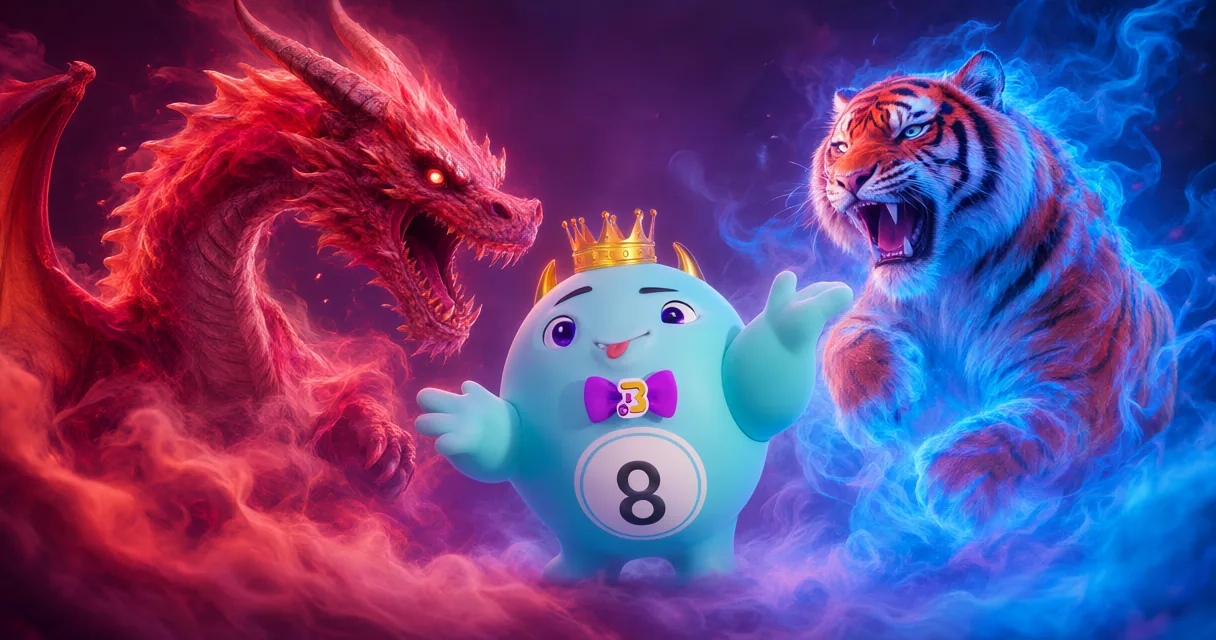
1 A Streamlined Design from the 1990s
Originating in Cambodian casinos during the 1990s, Dragon Tiger was explicitly built to offer a simpler alternative to baccarat. Instead of constantly comparing player and banker hand totals and memorizing conditional third-card drawing rules, you only need to track two single cards. The highest card wins outright, and standard suit variations generally do not affect the main outcome.
2 Transparent Card Scoring
Scoring requires absolutely no modulo-10 math. The system ranks the King as the highest possible outcome, worth 13 points, stepping down sequentially to the Ace, which holds the lowest value of 1 point. This direct hierarchy makes every resolution instant and entirely unambiguous for anyone watching the table.
3 Continuous 30-Second Rounds
The game operates on a continuous, rapid-fire schedule. Live Dragon Tiger broadcasts originate from professional gaming studio venues in Manila, Philippines, where English-speaking Filipino dealers host the tables. Each round finishes in approximately 20 to 30 seconds. Players are given a short, designated betting window of just 5 to 15 seconds before the cards are dealt, keeping the session moving at a brisk pace.
4 The Hidden Risks of the Tie Bet
The straightforward gameplay is balanced by specific payout structures. Winning bets on Dragon or Tiger typically pay out at one-to-one. Betting on a Tie offers much higher odds—often eight-to-one or eleven-to-one, with specific suited ties paying even more. However, if a round finishes in a Tie result, participating players who wagered on Dragon or Tiger only have half of their stake returned. Statistically, using a standard eight-deck shoe, the house edge for Dragon or Tiger hovers between 3.7% and 7.5%, while the house edge on a Tie bet jumps significantly, ranging from 10% up to 33%.
5 Expanding Into Multiplayer Tournaments
The format has also successfully expanded beyond standard single-player table bets. Competitive mobile Dragon Tiger tournaments now follow a recurring schedule, running every hour of every day. These competition events introduce organized multiplayer match structures, pitting participants against each other in 1-versus-1 and 2-versus-2 battle formats for an entirely different tactical angle.
 The Roulette Illusion: Why One Extra Green Slot Changes Everything
 What Is Sic Bo and How Is the Classic Dice Game Played in the Philippines?
 4 Key Phases of Blackjack: Rules, History, and Philippine Impact
 Digital Cockfighting: Safe Bet or Dangerous Illusion?